
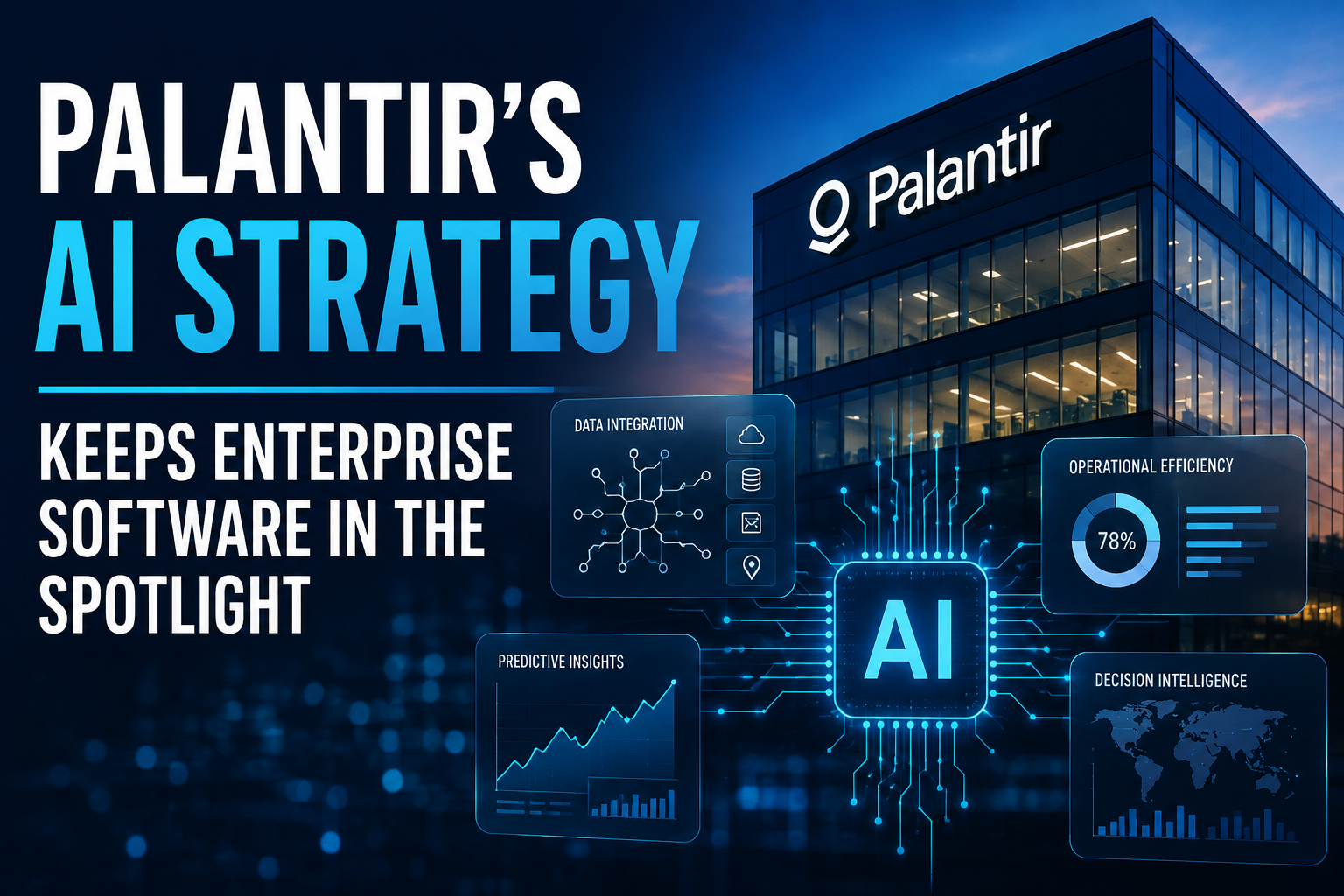
Palantir’s AI Strategy Keeps Enterprise Software in the Spotlight
Artificial intelligence continues to reshape the technology landscape, and few companies have embraced the enterprise AI revolution as aggressively as Palantir. Long known for its advanced data analytics platforms, the software company has increasingly positioned artificial intelligence at the center of its growth strategy, helping governments and businesses transform vast amounts of data into actionable insights.
As organizations accelerate digital transformation initiatives, Palantir’s AI-focused approach is drawing renewed attention from investors, enterprise customers, and industry analysts alike. The broader shift toward increasingly capable AI systems is also part of the evolution explored in what artificial general intelligence means.
Enterprise AI Becomes a Business Priority
Over the past several years, artificial intelligence has evolved from an experimental technology into a strategic business investment.
Organizations across industries are deploying AI to:
- Improve operational efficiency
- Automate repetitive tasks
- Enhance forecasting and planning
- Detect security threats
- Optimize supply chains
- Deliver faster customer insights
This shift has significantly increased demand for enterprise software platforms capable of managing large datasets while integrating advanced AI capabilities.
The growing demand is also contributing to the wider acceleration of enterprise AI adoption following strong technology earnings, as businesses increasingly look for measurable returns from their AI investments.
Palantir’s Expanding AI Vision
Rather than positioning itself solely as a data analytics provider, Palantir has increasingly emphasized AI-powered decision-making across its software ecosystem.
Its platforms are designed to help organizations:
- Connect data from multiple sources
- Build AI-driven workflows
- Analyze complex operational data
- Support real-time decision-making
- Deploy AI securely within enterprise environments
This integrated approach allows businesses to combine traditional analytics with modern machine learning tools without rebuilding existing infrastructure.
Why Enterprise AI Matters
Unlike consumer AI applications that generate text or images, enterprise AI focuses on solving operational challenges.
Businesses increasingly rely on AI to:
- Predict equipment failures
- Improve inventory management
- Detect fraud
- Optimize manufacturing
- Support healthcare decisions
- Strengthen cybersecurity
The ability to process massive volumes of information quickly gives organizations an opportunity to make faster, more informed decisions.
These systems also require significant computing resources, making AI infrastructure spending and its impact on the technology industry an important part of the enterprise AI story.
Growing Demand Across Industries
Artificial intelligence adoption is expanding well beyond the technology sector.
Industries investing heavily in enterprise AI include:
Healthcare
Hospitals and healthcare providers use AI to analyze medical data, improve diagnostics, and streamline administrative processes.
Manufacturing
Manufacturers increasingly deploy AI to monitor production lines, reduce downtime, and improve quality control.
Financial Services
Banks and financial institutions use AI for fraud detection, risk analysis, customer service automation, and regulatory compliance.
Energy
Energy companies apply AI to optimize infrastructure maintenance, forecast demand, and improve operational efficiency.
Government
Public-sector organizations continue investing in advanced data platforms to improve logistics, emergency response, defense planning, and public services.
Enterprise Software Remains Competitive
The rapid expansion of artificial intelligence has intensified competition among enterprise software providers.
Technology companies are racing to introduce:
- AI-powered assistants
- Intelligent automation tools
- Predictive analytics
- Machine learning platforms
- Workflow optimization software
- Data integration solutions
Businesses increasingly prefer platforms that combine these capabilities within existing enterprise systems rather than requiring entirely new technology stacks.
AI Adoption Comes with Challenges
While enthusiasm for enterprise AI remains high, organizations continue to face several implementation challenges.
These include:
- Data quality issues
- Integration with legacy systems
- Cybersecurity concerns
- Regulatory compliance
- Employee training
- Responsible AI governance
Successfully deploying AI often requires both technological investment and organizational change.
As AI becomes more deeply integrated into business operations, cybersecurity becomes an increasingly important consideration alongside productivity. Companies therefore need to account for the growing threat of AI-powered cybersecurity attacks as they expand their use of intelligent systems.
Investors Continue Watching Enterprise AI
Investor interest in enterprise AI companies remains strong as businesses increase technology spending.
Rather than focusing solely on experimental AI applications, many investors are paying closer attention to companies that generate recurring revenue through enterprise software subscriptions and long-term customer relationships.
The ability to deliver measurable productivity improvements has become an important factor when evaluating AI-focused technology companies.
This investment trend is occurring alongside the enormous capital commitments being made across the industry, including the Big Tech AI $1 trillion spending race, which highlights how seriously major technology companies are treating the infrastructure required for advanced AI.
What Businesses Should Consider
Organizations exploring enterprise AI solutions should begin with clearly defined business objectives.
Questions worth considering include:
- Which processes consume the most time?
- Where can automation improve productivity?
- Is existing data organized and accessible?
- What security and compliance requirements must be met?
- How will AI performance be measured?
Careful planning helps maximize returns while reducing implementation risks.
Looking Ahead
Artificial intelligence is rapidly becoming a standard component of enterprise software rather than a specialized feature.
Companies that successfully combine AI with secure data management, workflow automation, and real-time analytics are likely to remain central to the next phase of digital transformation.
As businesses continue investing in smarter decision-making tools, enterprise AI platforms are expected to remain a major area of innovation, competition, and investment across the global technology industry.
Key Takeaways
- Enterprise AI is becoming a core investment priority for organizations worldwide.
- Palantir continues emphasizing AI-powered analytics and operational decision-making.
- Businesses are adopting AI to improve efficiency, forecasting, automation, and security.
- Enterprise AI adoption extends across healthcare, manufacturing, finance, energy, and government.
- Organizations should balance AI innovation with strong governance, cybersecurity, and implementation planning.
- Demand for enterprise software with integrated AI capabilities is expected to remain strong as digital transformation accelerates.



2 Comments
Micle harison
June 7, 2019Lorem ipsum dolor sit amet, usu ut perfecto postulant deterruisset, libris causae volutpat at est, ius id modus laoreet urbanitas. Mel ei delenit dolores.
John Doe
June 7, 2019Some consultants are employed indirectly by the client via a consultancy staffing company.